The Walkthrough follows one 10-year component, where the two methods are less than 10% apart. That small gap is not typical. The difference grows with a component's lifespan, and the components that cost the most to fund are often the longest-lived.
The gap by lifespan
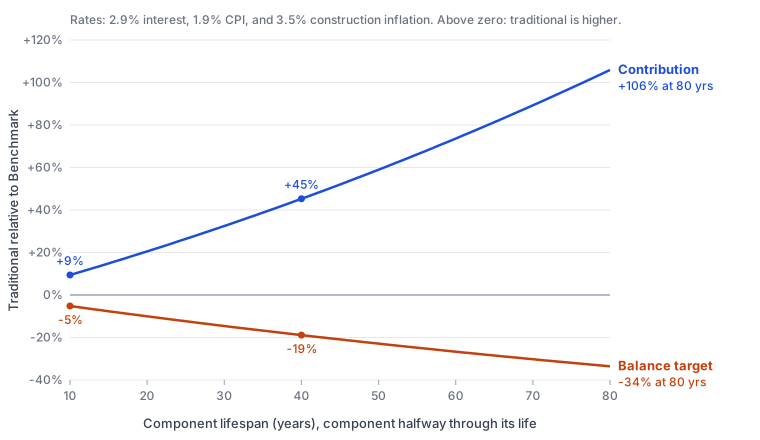
The chart follows a component halfway through its life, at the rates used throughout these pages: 2.9% interest, 1.9% general inflation (CPI), and 3.5% construction inflation. Each line shows how far the Traditional Method's figure sits above or below the Benchmark figure.
The longer a component lasts, the further apart the two methods get. The Traditional Method asks for a higher contribution and sets a lower balance target, and both gaps widen with lifespan, for two different reasons:
- Balance. The traditional balance target assumes interest, general inflation, and construction inflation are all the same. Over a short life the difference between them barely matters. Over 40 or 80 years it compounds.
- Contribution. The traditional contribution is the same dollar amount every year, while the Benchmark Contribution rises with inflation. To reach the same replacement cost, a flat payment has to start higher, and the longer the life, the higher it has to start. This happens even when all three rates are the same.
What this means for a whole building
A building's reserve fund covers many components, and the biggest ones carry the most weight. Building envelopes, roofs, parkade membranes, and elevators are often both the most expensive and the longest-lived, so they pull the whole building toward the right-hand side of the chart. That is why a whole building shows a much larger gap than the 10-year example. In the reports we have compared, the Traditional Method's first-year contribution typically came out 20–45% higher than the Benchmark.
Two more patterns hold across components:
- The balance gap is widest when a component is new and closes as its replacement approaches, so it is larger on newer buildings.
- The contribution gap grows slightly as a component ages.
Over a 30-year plan
The chart compares the two methods at one point in time. Across a 30-year funding plan, the comparison changes. The traditional contribution is calculated once and held flat, while the Benchmark Contribution grows each year, roughly with construction inflation across the whole fund, though not smoothly. In the reports we have projected forward, the Benchmark Contribution overtook the flat traditional contribution within about ten years and stayed above it for the rest of the plan.
The balance targets move apart as well. The traditional Reserve Requirements are carried forward from a flat ARFA, while the Benchmark balance is recalculated each year from the components' rising costs. How far apart they end up depends on the building: from a few percent to more than double by the end of the plan in the reports we have projected.
For owners, this is the fairness question. A plan built on the traditional figures asks today's owners to pay more, and later owners less, than the Benchmark does for the same components.
How we compared
We looked at eleven recent depreciation reports from different providers in British Columbia. Six of them included a benchmark we could check. For each of those six, we took the report's own components (their costs, lifespans, and ages) and its own interest and construction inflation rates, and calculated the Benchmark from them. That way, the only thing that changed was the method.
Three of the six used the Traditional Method as described on these pages. Their first-year contributions came out 22%, 23%, and 43% higher than the Benchmark. Those three are the reports we followed through their 30-year plans above.
The rates matter
The size of the gap depends on the rates a study uses. Where construction inflation runs further ahead of interest than in this example, every line on the chart sits further from zero. Where interest is well above construction inflation, the traditional balance target can come out higher than the Benchmark rather than lower. The balance targets only agree when interest, CPI, and construction inflation are all equal. The contributions differ even then, because ARFA is flat and the Benchmark Contribution grows with CPI.
Where to go next
- Go to Traditional Method: A Simple Check to follow one component and see where the traditional formulas stop agreeing with each other.
- Go to Formula Reference for the exact formulas behind the chart.
- Go to FAQ for common questions about how the two methods compare.